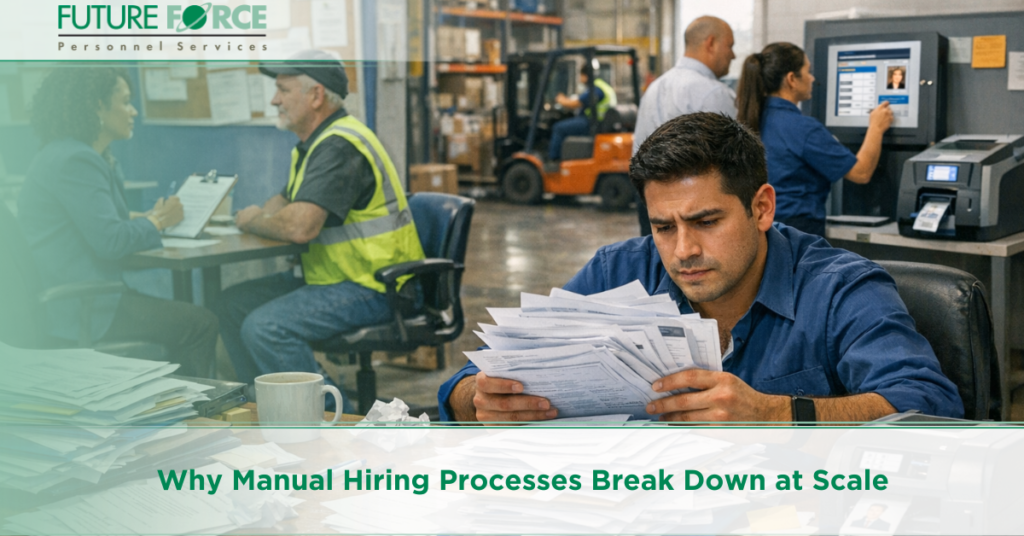
Staffing Automation for HR Teams: Why Manual Hiring Processes Break Down at Scale
Your HR Generalist, the person managing hiring, employee relations, compliance, and benefits for your organization, sits at their desk at 9 a.m. on a Tuesday with 47 unread emails about open positions, a spreadsheet of candidate names that hasn’t been updated in four days, three offer letters stuck in approval limbo, and a new hire starting tomorrow who still needs onboarding paperwork. Meanwhile, they also need to process an FMLA request, review health insurance changes, and handle a workplace conflict that landed in their inbox an hour ago. This is not a scheduling mishap. This is a staffing operation that has outgrown the system built to run it.
At small firms, the person managing hiring often wears every HR hat at once. When business grows, seasonal demand spikes, or unexpected turnover strikes, that one-person operation collapses under the weight of administrative tasks that were never designed to scale. The problem is not lack of effort or skill. The problem is a hiring workflow built for lower volume that nobody ever redesigned when the company did.
When One Person Is Running HR and Hiring at the Same Time
Practitioners in this field encounter a predictable pattern. A small firm operates smoothly with steady hiring volume, then growth forces them to hire multiple candidates in compressed timeframes, and the manual process breaks. Consider a manufacturing firm with 50 employees. The HR Generalist manages benefits, handles employee relations, ensures compliance, and recruits. Business is steady. Then the firm lands a contract that requires them to double production in six months. Suddenly, they need 20 new hires. The same HR Generalist now receives 80 applications in a single week, while also managing open enrollment for existing staff.
Without a system designed to handle volume, what happens is predictable. Resumes pile up in an email inbox. Applicants are logged into a spreadsheet where updates get missed. Hiring managers ask “Did we call that candidate?” and the HR person has to search through email threads to find the answer. Phone calls happen verbally with no written record. Candidates who were screened and interested hear nothing for a week, so they accept a job somewhere else.
This scenario is not unique to manufacturing. Hospitality, food distribution, warehousing, and administrative departments across South Florida, Orlando, and Atlanta face the same pattern: steady hiring becomes urgent hiring, and a process designed for three applications a week breaks when it has to handle thirty.
The bottleneck is not the HR person’s ability to recruit. It is a system that creates friction at every stage, tracking applicants, coordinating offers, processing onboarding, and forces one person to manually manage all three while also doing their regular job.
Common Applicant Tracking Problems That Create Hiring Bottlenecks
Without a centralized tracking system, applicant management fragments across multiple tools and people. Resumes arrive via email, a job board, LinkedIn, and a career page. Some are logged in a spreadsheet; others sit in an inbox folder. A hiring manager texts the HR person asking about a candidate they interviewed last week, forcing the HR person to dig through email to reconstruct the status.
Each missing piece of information introduces delay. A candidate waits three days for a response because the HR person didn’t see the note that screening was complete. A hiring manager moves forward with an interview before verifying that a background check was ordered. A qualified applicant never receives a rejection email, so they call the office asking what happened, consuming more HR time.
The cumulative effect is measurable in both time and opportunity cost. Candidates drop out when communication lapses. Follow-ups get missed. Hiring managers lose confidence in the process. The HR person spends hours reconstructing what should have been a simple status check, time that could have been spent on actual recruiting or on compliance work that cannot be delayed.
A manual tracking system also creates compliance risk. If a hiring manager asks “Did we check this candidate’s background?” and the answer is “I think so, but let me look,” you have a problem. Regulatory standards require documented proof that screening steps were completed in order. An informal system leaves gaps that surface only during an audit or a dispute.
The fix has two parts: a structured process and, ideally, a tool to execute it. Even without new software, defining a simple stage-gate workflow, applied, screened, interviewed, offered, hired, with a named owner and timeline for each step stops candidates from falling through cracks. Add a basic Applicant Tracking System (ATS), and the same workflow becomes automated. Status updates happen without manual email. Stalled candidates are flagged. Every stakeholder sees the same information at the same time.
Offer Coordination Issues That Delay Start Dates and Cost You Candidates
Offer coordination is a hidden bottleneck that many small teams do not recognize until they lose a candidate to it. The process sounds simple: finalize the offer details, draft a letter, get approval, send it to the candidate, collect their signed acceptance, and schedule the start date. In practice, with no system, it becomes a multi-week game of email tag.
Consider a realistic scenario: An HR Generalist prepares an offer letter for a new warehouse supervisor. The draft goes to the operations manager for sign-off. The operations manager is in a meeting, so it sits for two days. When they review it, they notice the salary is not aligned with their budget, a detail that should have been confirmed before drafting. The letter goes back for revision. Meanwhile, the candidate calls asking when they will receive the offer, because they have another job opportunity with a deadline. By the time the corrected letter is finally sent, the candidate has already accepted the other position.
This delay is compounded by scattered information. Compensation details might be in one document, benefits in another, and the start date verbally confirmed but never written down. Approval chains happen over email, creating no clear record of who approved what or when. Different candidates receive different letter templates, some with missing required language. Someone eventually discovers that one offer letter lacks the non-compete clause that the company requires, forcing a revision after the candidate has already signed.
The operational cost of this friction is real, but the candidate cost is higher. A delayed or disorganized offer process sends a signal that the company is not organized, which undermines the candidate’s confidence before they even start. Worse, it gives a competing employer time to formalize their offer first. Losing a candidate at the offer stage means restarting the search, which means reopening the applicant tracking backlog, which means more delay for the next candidate.
Standardized offer letter templates with pre-approved language tiers, one template for entry-level roles, one for supervisory roles, one for professional staff, eliminate the drafting bottleneck. Build those templates with required legal language already embedded, and approval time shrinks to confirming the salary and start date, not rewriting the entire document.
E-signature platforms integrated with those templates create a second efficiency gain. Instead of printing, signing by hand, scanning, and emailing back a document, a process that takes a week and introduces scanning errors, a candidate receives a digital offer, signs it in minutes, and the signed copy is automatically filed. The entire offer-to-acceptance cycle collapses from two weeks to two days.
Onboarding Paperwork That Creates Compliance Risk and Poor First Impressions
Onboarding is the first operational test of how organized your company is. A new hire arrives on day one ready to work. Instead, they spend the morning filling out tax forms, signing employee handbooks, completing I-9 verification, and waiting for IT to set up their login. If that paperwork is disorganized, forms are missing, instructions are unclear, or duplicates get processed, the new hire’s first impression is confusion and inefficiency.
The compliance exposure is also real. I-9 verification must be completed within three days of hire. Tax withholding forms must be accurate. Employee handbook acknowledgments must be documented. If onboarding paperwork is processed manually by hand, steps get skipped. One form is filed in the wrong folder. A signature is illegible. A date is missing. An audit later uncovers incomplete I-9 documentation or missing wage-and-hour acknowledgments, which creates liability.
At a small firm, the HR Generalist is often the only person processing this paperwork. They print forms, hand them to the new hire, collect them later, file them in different locations, and hope nothing gets lost. If the HR person is sick or on vacation when a new hire starts, nobody else knows which forms are required or where they go.
Digital onboarding platforms solve both the experience and compliance problem. A new hire receives a link to a secure portal, completes all required forms electronically, and the platform automatically flags missing information before submission. Tax forms are prefilled with company and candidate information, reducing errors. I-9 verification can happen electronically with a documented audit trail. All completed forms are stored in one searchable location. If the HR person is out, any team member can pull up the new hire’s records and see exactly what has been completed.
The operational benefit is time. Manual onboarding can consume 2 to 3 hours per new hire across printing, distributing, collecting, filing, and reconciling documents. Digital onboarding reduces that to 20 to 30 minutes of HR time, mostly just reviewing completeness before the platform files everything automatically.
Platforms offering employee portals with onboarding modules typically integrate with payroll and benefits systems, which means tax data flows directly into your payroll system without manual re-entry.
Warning Signs That Your Current Process Is Actively Hurting Your Business
Not every small firm faces the same staffing pressure, so not every firm needs an overhaul immediately. But certain warning signs suggest that your manual hiring process is no longer working and is actually costing you candidates and time.
-
Candidates fall out of the pipeline unexpectedly. You thought a candidate was still interested, but weeks pass and nobody contacted them. When you finally reach out, they have already accepted another job.
-
Hiring managers ask “What happened with this candidate?” and nobody knows. Status updates are verbal, scattered across emails, or exist only in the HR person’s memory. If that person is unavailable, information is lost.
-
Offer letters are delayed by more than a few days. Drafting, revision, approval, and sending stretch to a week or longer, and candidates call to check on status or withdraw their interest.
-
Onboarding paperwork is incomplete when a new hire arrives. Forms are printed on the fly, handed out haphazardly, and filed inconsistently, with a real risk that required documents go missing.
-
You discover compliance gaps during an audit. Background check documentation is incomplete, I-9 forms are missing signatures, or tax withholding information is inaccurate.
-
Your hiring manager expresses frustration with the hiring timeline. They want candidates placed faster, but the system cannot move any quicker because every step is manual and dependent on one person’s availability.
-
The HR person regularly works nights or weekends to manage hiring. This signals that the volume has exceeded the capacity of the current process, and burnout risk is high.
If you recognize three or more of these patterns, your hiring process has a system problem, not a people problem.
Workflow Solutions That Reduce Administrative Load Without Scaling Headcount
Fixing a broken hiring workflow does not require hiring a full-time recruiter or a dedicated HR coordinator. Most of the friction comes from information scattered across tools and people, not from lack of hands. Consolidating and automating that information flow releases the HR person’s time without adding cost.
Use a Simple Stage-Gate Process
Start with process before tools. Define every step from application through start date, assign a single owner to each step, and set a clear timeline. A basic framework might look like this:
-
Applied: Candidate submits application. Owner: HR. Timeline: Log within 24 hours.
-
Screened: HR reviews for minimum qualifications. Owner: HR. Timeline: Complete within 48 hours, send accept/decline email.
-
Interviewed: Hiring manager conducts phone or in-person interview. Owner: Hiring Manager. Timeline: Schedule within 24 hours of screening approval, complete within one week.
-
Reference Check: HR contacts references. Owner: HR. Timeline: Complete within 48 hours of interview.
-
Offered: Offer letter drafted, approved, sent. Owner: HR + Department Head. Timeline: Send within 48 hours of reference clearance.
-
Accepted: Candidate signs offer, start date confirmed. Owner: HR. Timeline: Collect signature within 48 hours of offer sent.
-
Onboarded: New hire completes all paperwork, training scheduled, systems access provisioned. Owner: HR. Timeline: Complete day one of employment.
Writing this down and sharing it with hiring managers creates accountability and stops the “What happens next?” question from becoming a bottleneck. Every stakeholder knows what they are responsible for and when.
Consolidate Applicant Tracking Into One Tool
Spreadsheets are free, which is why many small firms use them. They are also a bottleneck because updates require manual entry and sharing requires emailing versions back and forth. A basic Applicant Tracking System (ATS) designed for small teams, not enterprise-grade software, automates this consolidation.
Look for tools that offer:
-
Automatic applicant import from multiple sources (email, job boards, career website)
-
Customizable pipeline stages aligned with your process
-
Automated status update emails to candidates (no HR person composing them one by one)
-
Hiring manager visibility into pipeline status
-
Document storage (resumes, references, background check results) in one secure location
-
Mobile access so hiring managers can review candidates on the go
Many ATS platforms at the small-team level cost between $300 and $800 per month. For context, that is roughly equivalent to 4 to 8 hours of HR person time per month spent on manual tracking. If your current system already costs you that much in productivity loss, the tool pays for itself in efficiency alone.
Standardize and Automate Offer Letter Generation
Create two or three offer letter templates covering your typical role categories. Embed required legal language, non-compete clauses, equal employment opportunity statements, and at-will employment language directly into the template so it never gets forgotten.
Then integrate those templates with an e-signature platform. When an offer is approved, the HR person fills in salary, start date, and role-specific details, then sends a digital offer through the platform. The candidate receives it via email, signs it within a secure portal, and the system automatically files the signed copy in the candidate’s digital folder. No printing. No scanning. No “lost” signatures.
This also creates a compliance advantage. Every offer is generated from the same approved template, so legal language is consistent. The signed offer has a time stamp and authentication trail, which is stronger documentation than a scanned PDF of a handwritten signature.
Move Onboarding to a Digital Portal
A digital onboarding portal is not luxury software; it is a practical replacement for a folder of printed forms. New hires receive a link before their first day. They log in, see all forms they need to complete, fill them out electronically, and submit. The system flags missing information and prevents submission of incomplete forms.
What the HR person saves is time and errors. Forms are not misfiled. Signatures are not illegible. Tax information is not transposed incorrectly. New hires complete onboarding in 20 to 30 minutes instead of an hour. Completed forms are instantly searchable and always in one place.
Platforms offering employee portals with onboarding modules typically integrate with payroll and benefits systems, which means tax data flows directly into your payroll system without manual re-entry.
Establish a Single Point of Contact for Hiring Managers
One of the hidden costs of a fragmented hiring process is that hiring managers ping the HR person ad hoc: “Can you check on this candidate?” “Has the offer been sent?” “When does the new hire start?” These interruptions fragment the HR person’s day and create duplicate work when managers ask the same question multiple times because they didn’t get an answer the first time.
Designate the HR person as a single point of contact for hiring, with a clear agreement that all hiring questions go through them and are answered within 24 hours. This stops hiring managers from creating parallel processes or making their own calls to candidates. It also gives the HR person control over the calendar, so they can batch hiring tasks instead of jumping between emails and calls.
This is where process discipline pays off. If hiring managers know that the ATS shows real-time pipeline status and that the HR person will have an answer within 24 hours, they stop asking repeatedly. The HR person’s time is protected for focused work.
How to Build Sustainable Staffing Operations Before the Next Hiring Surge
The time to redesign your hiring process is not during the crisis, when you are drowning in applications. It is during the calm period when you have time to think strategically.
Start by mapping your current process. Document every step from application to start date, including who does what, what tool they use, and how long each step takes. This usually reveals redundancies and disconnects that nobody has seen before because everyone is focused on their own piece of the puzzle.
Next, identify which steps are manual and time-consuming. Tracking applicants in a spreadsheet? Drafting offer letters by hand? Printing and filing onboarding forms? These are your highest-impact automation targets.
Then, pick the single biggest bottleneck and solve it first. If you lose more candidates to slow offer turnaround than any other reason, fix offer coordination first. If your biggest frustration is finding candidate information buried in emails, move applicant tracking into a system first. One win builds momentum and makes the case for the next improvement.
Finally, document the new process and train everyone on it. A new tool or system only works if everyone uses it consistently. If the hiring manager still has a private spreadsheet of candidates, you have not actually consolidated anything.
When to Bring In Outside Help
No amount of process optimization can solve the problem of genuinely insufficient hiring capacity. If you have explosive growth, seasonal spikes, or high turnover that requires placing dozens of candidates in a compressed timeframe, hiring faster and better through internal process improvement has limits. At that point, the math shifts.
Outsourcing staffing administration, or the staffing function itself, transfers the administrative load entirely. Instead of your HR Generalist managing applicants, coordinating offers, and processing onboarding, a staffing partner handles all of it. Your HR person regains time for compliance, employee relations, and strategy, and hiring happens without the bottleneck.
Start by auditing what a hiring surge actually costs your current process. Time spent, delayed placements, lost candidates, compliance risk. Then compare that cost to the cost of outsourcing. For many small firms, a staffing partner becomes a financial win before it even factors in the operational relief.
If you are managing hiring workflows across multiple departments, hiring for both temporary and permanent roles, or facing seasonal demand that makes it hard to justify a dedicated recruiter year-round, talking to Future Force Personnel about on-site staffing management or full-service hiring administration is worth the conversation.
Start Where You Are
Fixing a hiring process that has outgrown its system does not require a complete overhaul on day one. It requires a clear-eyed assessment of where the friction actually is, one targeted fix that reduces the most urgent bottleneck, and a commitment to keeping the process documented and sustainable.
Your HR Generalist is not drowning in paperwork because they are not capable. They are drowning because the process was designed for lower volume and was never redesigned when the business grew. A structured, documented workflow combined with even basic automation releases time that gets absorbed back into the work that actually requires a person’s judgment and attention.
Audit your current staffing automation needs today. Map where candidates get stuck, where approvals delay offers, and where onboarding paperwork creates risk. Pick one bottleneck and fix it. Then move to the next. Small changes compound into a system that scales without proportionally scaling your headcount.