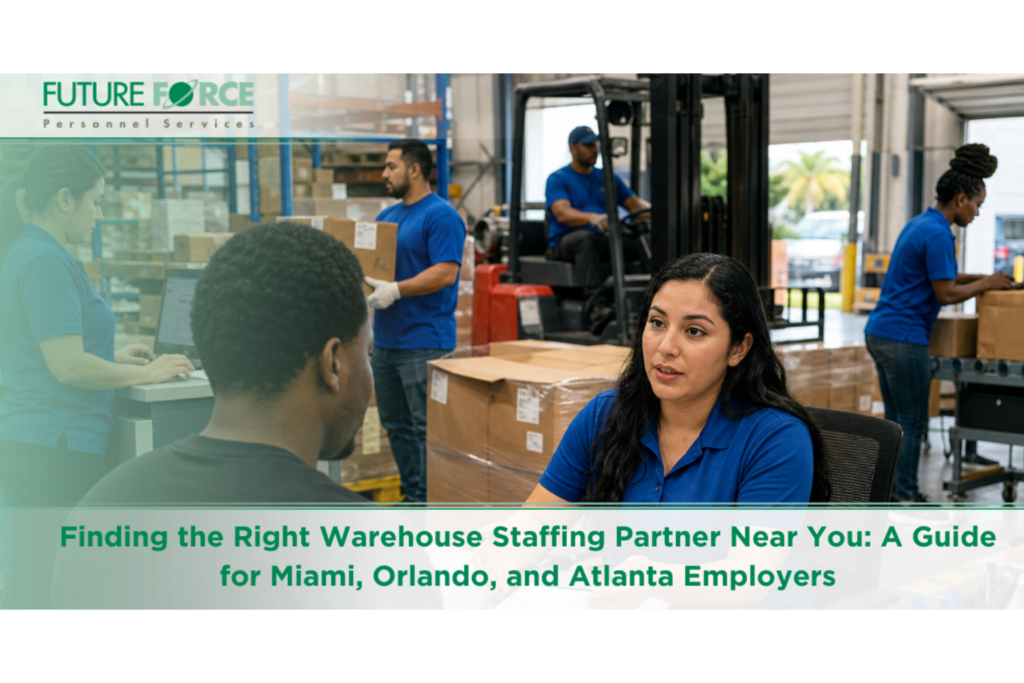
Choosing a warehouse staffing partner isn’t just about filling shifts, it’s about aligning on process, safety and workflow before the first worker ever steps onto your floor. When the partner supplies vetted workers who understand your safety rules, inventory accuracy standards and shift scheduling, the whole operation runs smoother: fewer overtime spikes, better on-time delivery, and metrics you can actually act on. Future Force Personnel has staffed light industrial, warehouse and logistics roles across South Florida, Orlando and Atlanta since 1992, and this guide reflects what consistently separates a partner that fills seats from one that improves your operation.
A warehouse staffing partner should source, screen and place workers who fit your specific safety program, shift patterns and pick/pack/ship requirements, not just send bodies to cover an open slot. The right partner reduces turnover, incident rates and time-to-fill at once, not one at the expense of the others.
What to look for in a warehouse staffing partner
Industry experience. Prior work with e-commerce fulfillment, cold storage or reverse logistics specific to your operation type.
Safety and compliance. Documented certifications, training programs and a track record of reducing incidents, ask for actual numbers, not a general assurance.
Quality of applicants. Screening, skills testing and verified references for pick/pack, forklift certification and carrier-specific requirements (UPS, FedEx and similar).
Scalability. The ability to ramp up quickly for peak season or a promotional event without a two-week lead-time surprise.
Technology and visibility. Real-time staffing dashboards, timekeeping and performance data you can pull without asking.
Local knowledge. Familiarity with your specific labor market, commute patterns and peak periods; Miami, Orlando and Atlanta each behave differently, covered below.
Common pitfalls to avoid
Partnering with a firm that doesn’t screen for safety or skip training on your specific warehouse processes creates risk you won’t see until an incident happens. Overreliance on the lowest-cost option without quality assurances tends to show up later as higher turnover and more downtime than it saved in fees, the same pattern shows up in what happens when a distribution center hires reactively on a tight budget. And a partner with missed SLAs or no transparency into candidate availability and substitution rules leaves you scrambling exactly when you can least afford it.
Regional considerations: Miami, Orlando and Atlanta
Each metro has distinct labor dynamics, seasonality and regulatory nuances, and a partner working all three should tailor onboarding, rotation and retention strategy accordingly, not run one national playbook.
Miami and South Florida. Higher turnover and a large seasonal surge require a partner who can source bilingual workers and manage late-shift scheduling reliably.
Orlando. Proximity to theme-park supply chains and hospitality-driven fulfillment creates sharp demand spikes tied to specific events and seasons, not just holidays.
Atlanta. A dense manufacturing and distribution corridor puts more weight on long-term worker reliability and cross-docking capability than on rapid seasonal ramp.
Safety and training alignment by region
Confirm the partner’s safety program actually matches your operation, forklift compliance, hazard communication, lockout/tagout procedures and apparel requirements for cooler or cold-storage environments. Ask for evidence of recent safety audits and incident rates benchmarked against Florida and Georgia industry averages, not just a general safety pledge. If your locations span multiple states, a centralized compliance and onboarding checklist is worth asking your partner about directly, inconsistent documentation across sites is a common source of hidden delay.
Workforce availability patterns
Ask directly how the partner plans for weather-related disruptions, local event calendars and school schedules, and how they maintain a ready pool of qualified workers for on-demand needs rather than starting a search cold when you call.
How to evaluate candidate workers from a staffing partner
-
Clarify required skills up front: forklift operation, order-picking methods, pallet jack use and WMS familiarity.
-
Request a structured assessment, skills tests, a safety knowledge check, and ideally a trial shift to observe real performance.
-
Check reliability and communication: on-site supervisors, substitution alert systems and a clear escalation path.
-
Verify compliance: I-9 verification, work eligibility and drug-free program details.
-
Assess adaptability: teamwork, shift reliability and readiness to learn new processes on the floor.
Building a collaborative staffing plan
A successful plan blends your workflow with the partner’s actual capacity, not their sales pitch. Start with a forecast covering baseline staffing, peak weeks and a contingency buffer, this matters most when seasonal demand spikes arrive on a predictable calendar but staffing stays reactive, which is the single most common gap we see in distribution centers. Schedule regular reviews to adjust for actual demand, turnover and performance, a practical cadence is a quarterly check on fill rate, time-to-fill and pick quality, used to jointly optimize scheduling and training rather than just reporting numbers back to you.
Implementation steps for onboarding a new partner
-
Define success with measurable goals, for example, 98% on-time shipments and under 2% pick errors.
-
Set clear SLAs for fill rate, substitution response time and incident reporting.
-
Provide an operational playbook covering safety rules, shift handoffs, equipment use and WMS interactions.
-
Schedule joint training aligned on your standard operating procedures and quality checks.
-
Establish a communication cadence, weekly reviews, dashboards and an issue-resolution protocol.
-
Run a 4, 6 week pilot with defined metrics and a plan to scale or adjust before committing further.
Measuring success and continuous improvement
Track fill rate, overtime reduction, incident rates and order accuracy, and review performance with your partner on a set schedule rather than only when something goes wrong. Use feedback from frontline supervisors, the people who actually see shift-to-shift performance, to improve screening, onboarding and retention strategy over time.
An illustrative scenario
Consider a distribution center in South Florida relying on temporary staff to cover peak season. Working with a partner who standardizes safety training across shifts, uses a templated onboarding process, and maintains a real-time pool of ready workers typically shows up in fewer overtime spikes and a faster average time-to-fill within the first few months, the kind of result a structured onboarding pilot with visible dashboards is designed to produce. This is an illustrative pattern, not a specific client’s reported numbers, but it reflects what a well-run partnership consistently delivers.
Key takeaways
-
The right partner reduces turnover, incidents and time-to-fill together, a cheap option that trades one for the others isn’t actually saving you money.
-
Miami, Orlando and Atlanta each have distinct seasonality and labor dynamics; a one-size-fits-all playbook underperforms a regionally tailored one.
-
Ask for actual safety and performance numbers during due diligence, not general assurances.
-
A defined pilot with measurable SLAs is the lowest-risk way to test a new partner before scaling.
Preparing your team for what’s next
Start shortlisting partners with real regional experience, verify safety practices with actual data, and request a pilot to compare performance before committing broadly. A practical next step is a 30-day evaluation with defined metrics and a visible reporting dashboard. Consider too how the partner integrates with your existing ERP or WMS, a partner who can push data into your systems reduces manual entry and speeds up decisions. When evaluating proposals, ask for a live demonstration of dashboards, substitution alerts and how they plan for seasonality, and involve warehouse operations, HR and IT together in the review, that cross-functional alignment is usually where the real gains come from.
Future Force Personnel has staffed light industrial and warehouse and logistics roles across Miami, Orlando and Atlanta since 1992, see why businesses choose a regional partner over a national agency when speed and local knowledge matter. Request an employee to start a pilot, or contact our team in Miami, Orlando or Atlanta.
Looking for warehouse or light industrial work yourself? Search current openings across all three markets.
Frequently asked questions
How soon can a staffing partner fill a new warehouse shift? Most experienced partners can mobilize a ready pool of workers within 24, 72 hours for standard shifts, with faster options available for urgent needs.
What should I ask a warehouse staffing partner during due diligence? Ask about actual safety records and incident rates, turnover rates, client references, their technology stack for dashboards and timekeeping, and how they handle weekly or monthly demand forecasting.
Do warehouse staffing needs differ between Miami, Orlando and Atlanta? Yes. Miami sees higher turnover and seasonal surges requiring bilingual sourcing; Orlando’s demand spikes track theme-park and hospitality supply chains; Atlanta’s manufacturing and distribution corridor rewards long-term worker reliability over rapid seasonal ramp.
How long should a pilot with a new staffing partner run before I commit to a broader rollout? A 4, 6 week pilot with defined SLAs, fill rate, substitution response time, incident reporting, is typically enough to see whether a partner’s actual performance matches their proposal.