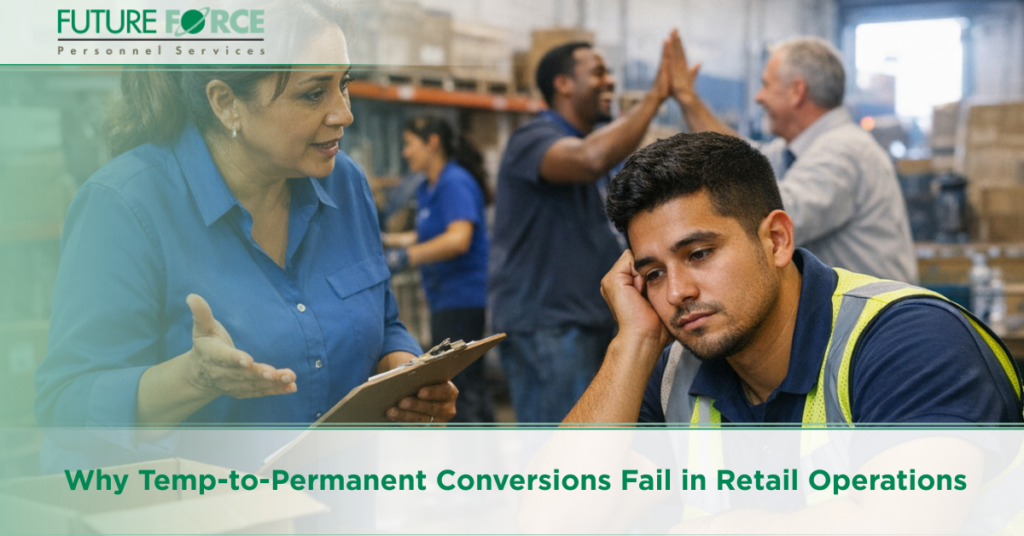
A store manager calls the staffing agency on a Thursday afternoon. The temp worker the agency placed three weeks ago—solid performer, reliable, good with customers—just texted that they won’t be coming in Monday. No one ever explained what permanent employment would look like, when it might happen, or whether they qualified for benefits. The manager is frustrated. The staffing team is frustrated. The worker is gone before a conversion conversation even starts.
If you oversee multi-unit retail or hospitality operations, this story probably feels familiar. Temp-to-permanent conversions that should be straightforward instead fall apart at the last moment and do so across multiple locations. In most cases, the issue is not worker performance. Structural gaps and weak communication create confusion, undermine belonging, and allow people to leave long before anyone realizes retention is at risk.
This guide unpacks the specific barriers that derail conversions in retail environments and presents a practical retention and transition framework built for the pace and complexity of multi-location operations.
What the Data Shows About Temp Conversions
In our work with multi-unit retail operations across the Southeast, conversion patterns are consistent. Nearly one in three temp workers never receives a formal conversion discussion at all, and roughly another third declines offers at the last moment when an offer finally appears. These workers are not unreliable; they are reacting rationally to unclear signals and inconsistent treatment.
Once you recognize this as a structural problem rather than an individual one, you can start fixing the process instead of blaming the people.
How Conversions Fall Apart in Practice
Regional HR managers often describe a recurring pattern. A temp worker performs well for several weeks. Attendance is strong, customer feedback is positive, and supervisors are happy. Then the worker either disappears before the conversion window closes or politely declines a permanent offer when it finally arrives.
At first, it is tempting to assume temp workers are fickle or that conversion timelines are inherently unpredictable. A closer look reveals something else. The underlying cause is usually the way the organization treats temp-to-permanent as a paperwork event rather than a planned transition.
From the worker’s perspective, the job doesn’t change when the offer arrives. No one has walked them through what “permanent” means, which benefits they gain, how schedules will adjust, or what growth opportunities exist. The message they receive—despite good performance—is that they were never fully part of the team.
A Ground-Level Example
Consider a regional grocery chain with a distribution center in Miami-Dade. The company brings in a temp worker for a seasonal ramp-up. During the first two weeks, this person shows up every day, learns dock procedures, and handles tasks well.
However, the worker wears a different-colored vest than permanent staff. They’re not invited to the team lunch the store manager hosts. They miss the morning huddles where priorities are set. After four weeks of solid performance, an automated email mentions a permanent opening. By that time, the worker has already applied elsewhere. The signals they received suggested they were extra labor, not a real team member. They accept a job with another employer before any conversion discussion happens.
Examples like this repeat because the same core barriers show up again and again: unclear timelines, weak belonging, misaligned expectations between agency and managers, and inconsistent experiences across locations. None of these require expensive fixes, but all of them require intentional design.
Problem 1: No Real Transition Plan Beyond HR Paperwork
The most basic gap in failed temp-to-permanent conversions is the lack of a defined transition process. HR sends paperwork, maybe a manager mentions that a permanent position “could open,” and the worker is left to guess what comes next.
When timelines aren’t explicit, temp workers fill in the blanks themselves. They do not know whether conversion is real or hypothetical. They do not know when benefits might start, how the schedule will change, or whether advancement is possible. That uncertainty steadily pushes people to pull back effort and start interviewing elsewhere.
In busy retail environments, clarity is one of the strongest retention tools you have. Workers who understand the path to permanence and see specific steps laid out are far more likely to stay engaged.
How to Build a Real Transition Plan
You can turn conversion into a predictable process rather than a vague promise:
-
Create a written 30-day conversion roadmap that begins on day one of the temp assignment, not on the day the offer goes out. Share this roadmap with the worker, the store manager, and your staffing partner so everyone operates from the same calendar.
-
Schedule three structured touchpoints:
-
A mid-period check-in around day 10–14 focused on performance and questions.
-
A pre-offer conversation around day 20–25 to confirm expectations and timing.
-
A formal conversion discussion around day 28–30 where the offer, schedule, pay, and benefits are presented clearly.
-
-
Define what “permanent” means for this role: expected schedule, benefit eligibility timeline, pay structure, training plans, and any probation period. Put these details in writing so the offer feels concrete.
-
Align this roadmap with your staffing partner so they can reinforce the plan with the worker and alert you early if someone starts disengaging.
Problem 2: Temp Workers Never Truly Feel Like They Belong
Another common pattern is how temp workers get treated day to day. They may wear different uniforms, stand outside team meetings, miss informal communication, or quietly feel like “extra hands” instead of colleagues. After a week or two of those signals, many start looking for other opportunities.
Belonging is not a soft, optional idea in this context. It directly affects whether a worker shows up consistently, engages with customers, and accepts a permanent offer. People who feel excluded are unlikely to invest emotionally in the role and will leave as soon as a better alternative appears.
The opposite is also true. Temps who participate in shift huddles, receive recognition, attend team events, and see themselves as potential permanent members from the beginning are significantly more likely to stay and convert.
How to Create Belonging From Day One
Building belonging does not require new budget lines; it requires deliberate practices:
-
Pair each temp with a peer buddy from the permanent team during the first week. The buddy’s job is to explain how work actually happens on the floor, answer informal questions, and include the temp in team moments. This simple step often improves early retention at almost no cost.
-
Invite temp workers into shift huddles, recognition rituals, and relevant communication channels immediately. Avoid waiting for the conversion offer to treat them as part of the team.
-
Use the same uniform or a clear badge that indicates they are legitimate members of staff, not just outsiders, so customers and colleagues know how to interact with them.
-
Make temps eligible for the same recognition you offer permanent employees. If you celebrate customer compliments or performance milestones, include temporary staff in that system.
Problem 3: Expectations Are Misaligned Across Agency, Managers, and Workers
Many conversion failures can be traced to mismatched assumptions. Store managers often expect staffing agencies to “manage” the temp and signal when conversion is appropriate. Agencies assume managers will initiate the conversation when they’re ready. Workers assume someone will tell them clearly if a permanent job is coming. In practice, no one owns the timeline.
This misalignment is amplified in multi-unit operations. Different managers hold different expectations, use different timelines, and maintain different relationships with the agency contact. The result is uneven worker experiences and unstable conversion rates.
How to Align Expectations Upfront
Clear alignment at the beginning of an assignment prevents confusion later:
-
Hold a short three-way kickoff conversation involving the staffing contact, the store manager, and ideally the temp worker. Review conversion timing, performance criteria, and who will initiate the conversion discussion.
-
Follow that call with a simple written summary—an email is enough—so everyone can revisit what was agreed.
-
Assign a single accountable owner for tracking conversions across locations. In many organizations this is a district manager or the agency’s account manager, rather than each individual store leader.
-
Establish explicit triggers for a conversion conversation. For example: “If attendance stays above 95% and performance meets standards for 30 days, the manager schedules a conversion meeting.”
A Field Example: A Services Company Applies the Framework
A regional services company that staffs field technicians for consumer electronics retailers across several states decided to formalize its conversion process. The team implemented a 30-day roadmap, peer buddies for every temp, and a named conversion coordinator for each district.
Within two quarters, they reported noticeable shifts:
-
Average time from initial assignment to formal conversion discussion dropped from 28 days to 21 days.
-
Acceptance rates for temp-to-permanent offers increased from roughly two-thirds to nearly nine out of ten.
-
First-year retention for converted staff climbed by double digits.
Managers described the new process as a clear progression rather than a vague possibility. Workers reported feeling included in the team from day one, which encouraged them to stay through the conversion window and beyond.
Practitioner Insight: What Operators See on the Floor
Regional people operations leaders often observe that the offer itself is not the decisive moment. The way temp workers are treated in the weeks before the offer sets the outcome.
When temporary staff sit in morning huddles, receive consistent feedback, and see a real path forming, they begin behaving like permanent employees long before HR sends a contract. That behavioral shift mirrors the framework’s core emphasis: clarity, belonging, and aligned expectations drive conversions, not the existence of a job opening.
The Retention Framework: Three Pillars You Can Implement Now
The practical framework rests on three pillars—transition clarity, belonging, and accountability. Each pillar contains specific actions you can use even in high-volume retail or hospitality operations.
1. Transition Clarity
-
Publish a simple, universal 30-day conversion roadmap for temp roles.
-
Make sure the roadmap is visible to the worker, the store team, and the staffing partner.
-
Commit to three fixed touchpoints with documented outcomes: progress check-in, pre-offer discussion, and formal conversion meeting.
-
Define “permanent” in precise terms: schedule, benefits, pay ladder, training expectations, probation period, and advancement opportunities.
2. Belonging From Day One
-
Pair every temp with a permanent employee buddy and set a weekly touchpoint during the first month.
-
Include temps in team rituals from their first shift—huddles, recognition moments, and appropriate social channels.
-
Use uniforms or badges that make them visibly part of the team, reducing ambiguity for customers and colleagues.
-
Ensure recognition programs cover temporary workers as well as permanent staff.
3. Clear Accountability and Alignment
-
Run a three-way kickoff meeting for each placement—staffing partner, store manager, and worker—to align expectations and conversion triggers.
-
Document the plan and share it with all stakeholders, including regional or district leaders.
-
Name one person as owner of the conversion timeline and escalation path when delays or issues arise.
Turning Insight Into Action
Temp-to-permanent conversions in retail do not fail because workers care less. They fail when the organization treats conversion as a formality instead of a managed transition, leaves temps on the outside of team culture, and never clarifies responsibility for the process.
You can change that pattern with targeted steps:
-
Publish a 30-day transition roadmap for temp roles.
-
Assign a buddy to every temp worker to foster belonging immediately.
-
Schedule a three-way kickoff conversation with your staffing partner and each manager before assignments begin.
These moves create clarity, inclusion, and shared accountability—conditions that support both conversion rates and long-term retention across locations.
If you are ready to adapt this framework to your multi-unit retail or hospitality environment, you can start by mapping your current conversion process and identifying where clarity, belonging, or ownership are missing. From there, building a tailored roadmap and role definitions becomes much easier.
Contact us today to develop a conversion plan that fits your operations and helps temp workers see a clear, credible path to permanent employment.